DSTI in Portugal: Banco de Portugal lowers the maximum debt ratio from 50% to 45%
What’s changing and what it means for your property project
On July 2, 2026, Banco de Portugal announced a revision of its Macroprudential Recommendation applicable to new mortgage and consumer credit. At the heart of this revision: a reduction of the maximum allowed debt ratio, known as DSTI, which drops from 50% to 45%. Although it has attracted little media attention, this measure will directly reduce the borrowing capacity of many buyers, residents and non-residents alike.
Here’s everything you need to know.
What is DSTI?
DSTI (Debt Service to Income) measures the weight of a borrower’s total monthly credit repayments (mortgage + ongoing consumer credit + recurring charges) relative to their monthly income. In practical terms: how much of your salary goes each month toward repaying your debts.
This ratio is calculated with two additional layers of caution imposed by Banco de Portugal: an interest rate stress test (a rate increase is simulated to verify the borrower would still be able to pay) and, in some cases, an income reduction after age 70. This means the borrowing capacity calculated by banks is always more conservative than if the rate in effect at the time of the loan were simply used.
What’s actually changing
The new DSTI ceiling drops from 50% to 45%, with the goal of containing the rise in household debt and making the assessment of borrowers’ financial capacity more prudent. In plain terms: banks must now be stricter about how much they agree to lend relative to the borrower’s income.
When does the measure take effect?
The new rules apply to contracts for which the borrower’s solvency assessment takes place from August 1, 2026 onward, giving banks just over a month to adapt since the announcement. In practice, if your credit file was assessed by the bank before that date, the previous 50% ceiling could still apply; after that date, the new 45% ceiling prevails.
Why did Banco de Portugal make this decision?
Banco de Portugal justifies this decision by the strong growth in household credit, the increase in average loan amounts, and the deterioration of risk indicators observed in recent months. Governor Álvaro Santos Pereira had in fact announced this intention as early as the presentation of the Financial Stability Report at the end of 2025. According to Banco de Portugal, the reduction of the DSTI ceiling is preventive in nature, aimed at mitigating systemic risk: by limiting new contracts with higher effort ratios, the measure reduces the probability of default and losses in the event of default.
In other words: the central bank wants to prevent Portuguese households from taking on debt beyond their real repayment capacity, in a context of rising property prices.
Concrete example #1: net salary of €2,000/month
For a borrower with a net monthly income of €2,000, with no other ongoing credit:
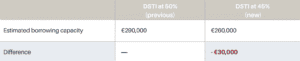
Result: for an identical profile, a loss of €30,000 in borrowing capacity can be observed simply from the change in the regulatory ceiling, with no personal circumstances having changed.
Concrete example #2: net salary of €1,500/month
For a borrower with a net monthly income of €1,500, with no other ongoing credit, the same logic applies proportionally:
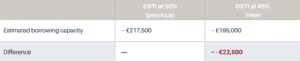
These amounts are indicative estimates based on standard rate and term assumptions, given for illustrative purposes. Every case is unique: the actual amount depends on the interest rate offered, the loan term, ongoing credit, the borrower’s age, and each bank’s own policy.
The other changes included in the same recommendation
The DSTI reduction is the headline measure, but the revision also touches other parameters worth knowing if you’re preparing to buy:
Simplified loan maturity: there is no longer a single average maturity limit, it has been replaced by two ceilings based on age: 40 years for borrowers aged 35 or under, and 35 years for borrowers over 35.
Reduced exception margin: whereas banks could previously deviate from the recommendation for 15% of their loans (with two grounds for exception), this margin is now limited to 10% of the amount of new loans, with no DSTI ceiling in these specific cases.
100% LTV removed for properties owned by the banks themselves, which now follow the general LTV limit regime.
Real estate leasing excluded from the scope of the recommendation, given its limited presence in the Portuguese market.
A recommendation, not (yet) a law
An important point to keep in mind: these new rules remain, for now, a recommendation and not a binding legal obligation for banks, which retain the “comply or explain” principle. In other words, a bank could in theory deviate from this limit if it justifies its decision, but in practice, almost all Portuguese banks have scrupulously followed macroprudential recommendations since their introduction in 2018.
Also worth noting: the IMF has recommended that Banco de Portugal turn this recommendation into a binding rule in the future, which could further tighten the framework in the years to come.
What this means for your project
In practical terms, if you’re planning to buy a property in Portugal in the coming months, here’s what to anticipate:
Revise your budget downward, or plan for a larger personal contribution to offset the reduced borrowing capacity.
Pay off your ongoing consumer credit if possible before applying: every existing monthly payment reduces your capacity for new borrowing by that much.
Compare banks: some apply the recommendations with more or less flexibility depending on the file, notably through the 10% exception margin.
Get a personalized simulation and have a broker guide you before committing to a property,the figures above are ballpark estimates, not an individual calculation.
In summary
Banco de Portugal has tightened the conditions for accessing mortgage credit by lowering the maximum DSTI from 50% to 45%, applicable to files assessed from August 1, 2026 onward. A preventive measure, designed to limit household over-indebtedness, but one that changes the game for anyone planning to buy in Portugal.
Want to know exactly what this measure changes for your own project?
Contact Spread Hunters for a free, personalized simulation: comercial@spreadhunters.pt